Lessons
Here you will find two kinds of code:- Examples and their solutions
- Challenges
Example: Print hello world
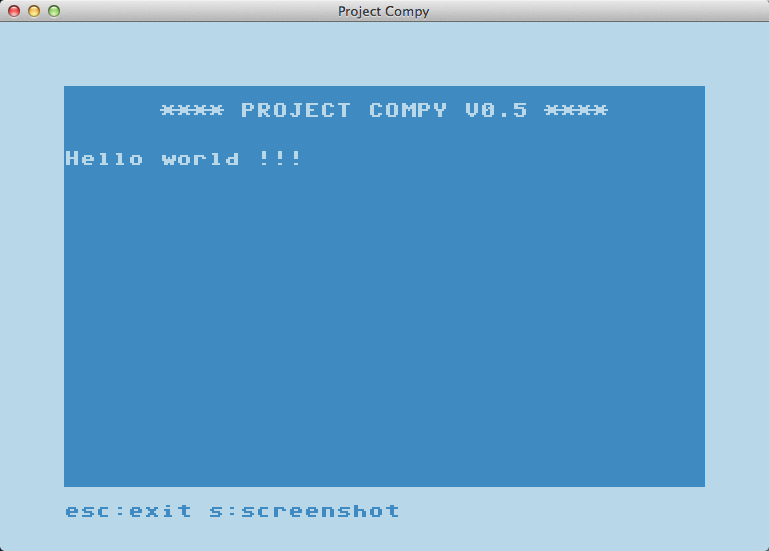
This is your first program, find it at the root base, run it with this command pythonw ex_print_hello_world.py
 def my_program():

    printf('Hello world !!!')


###########################################################################
###########################################################################
# The next lines are needed to run compy, don't mind them,
# but keep them, don't get rid of these lines
###########################################################################
###########################################################################
import compy
import time

# define commands of compy, so IDE's will recognize them
def clear_screen(): pass
def set_bg_color(color): pass
def set_fm_color(color): pass
def printf(to_print='', color=None, stay=False, reverse=False): pass
def xyprintf(x, y, *args): pass
def poke(x, y, code, color = None, reverse=False): pass
def peek(self, x, y): pass
def input(message = '', color=None): return None
def wait_key(): pass
def check_key(): pass

def redefine_commands_and_run(screen):

    global clear_screen, set_bg_color, set_fm_color, printf, xyprintf
    global poke, peek, input, wait_key, check_key

    clear_screen = screen.clear_screen
    set_bg_color = screen.set_bg_color
    set_fm_color = screen.set_fm_color
    printf = screen.printf
    xyprintf = screen.xyprintf
    poke = screen.poke
    peek = screen.peek
    input = screen.input
    wait_key = screen.wait_key
    check_key = screen.check_key

    my_program()

if __name__ == '__main__':
    compy.run(redefine_commands_and_run)

###########################################################################
###########################################################################
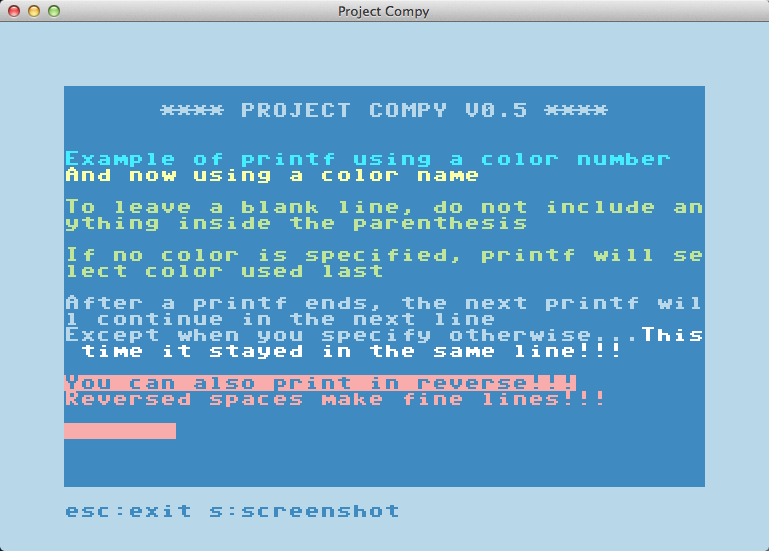
Example: Learn how printf works
Look at the way printf wraps the line at the end of the screen. Also look at how you control the color printed. Take a look at the reversed mode and also how to make the next line to be printed following the current one
Challenge: Draw one line
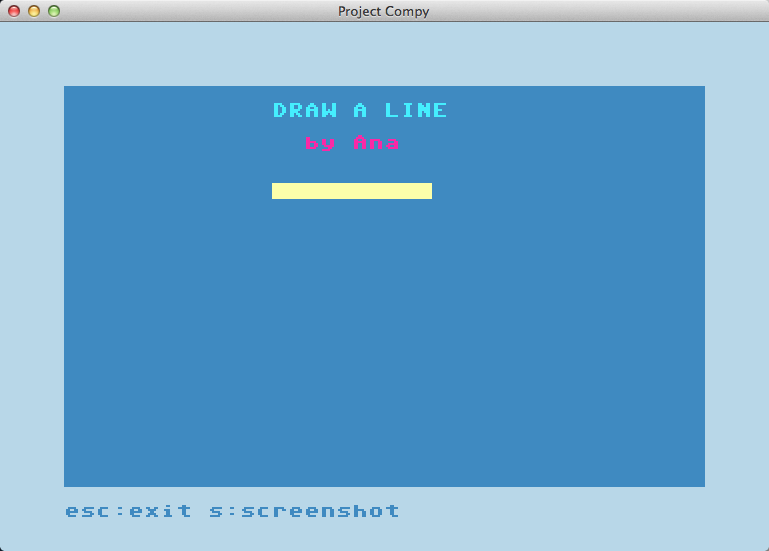
Can you draw a yellow line in the middle of the screen? (Ana did)To do it you will need to create a new text file, you can call it my_python_program.pyand run it with this command pythonw my_python_program.py
 def my_program():

    clear_screen()

    printf()
    printf('             DRAW A LINE', color=17)
    printf()
    printf('               by Ana', color=19)
    printf()
    printf()

    printf('             ', stay=True)
    printf('          ', reverse = True, color = 'light-yellow')


###########################################################################
###########################################################################
# The next lines are needed to run compy, don't mind them,
# but keep them, don't get rid of these lines
###########################################################################
###########################################################################
import compy
import time

# define commands of compy, so IDE's will recognize them
def clear_screen(): pass
def set_bg_color(color): pass
def set_fm_color(color): pass
def printf(to_print='', color=None, stay=False, reverse=False): pass
def xyprintf(x, y, *args): pass
def poke(x, y, code, color = None, reverse=False): pass
def peek(self, x, y): pass
def input(message = '', color=None): return None
def wait_key(): pass
def check_key(): pass

def redefine_commands_and_run(screen):

    global clear_screen, set_bg_color, set_fm_color, printf, xyprintf
    global poke, peek, input, wait_key, check_key

    clear_screen = screen.clear_screen
    set_bg_color = screen.set_bg_color
    set_fm_color = screen.set_fm_color
    printf = screen.printf
    xyprintf = screen.xyprintf
    poke = screen.poke
    peek = screen.peek
    input = screen.input
    wait_key = screen.wait_key
    check_key = screen.check_key

    my_program()

if __name__ == '__main__':
    compy.run(redefine_commands_and_run)

###########################################################################
###########################################################################
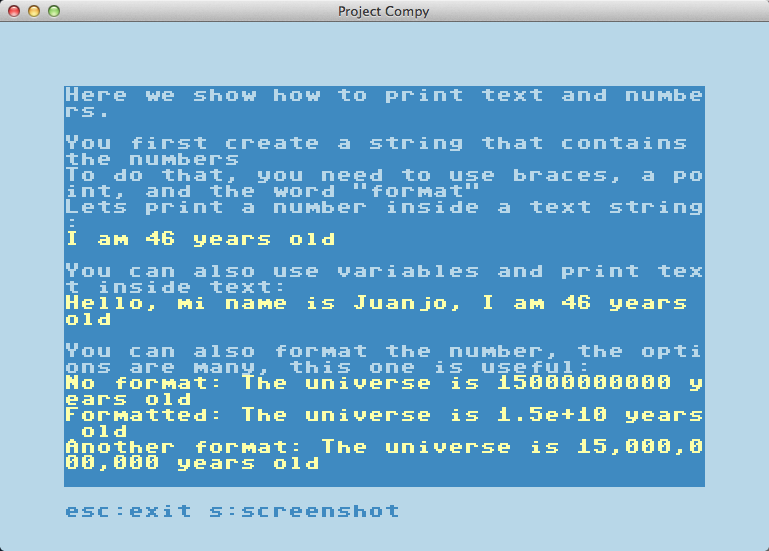
Example: Print text and numbers
Look at the way to print numbers inside a string
 def my_program():
    clear_screen()
    msg = 'Here we show how to print text and numbers.'
    printf(msg)

    printf()

    printf('You first create a string that contains the numbers')
    printf('To do that, you need to use braces, a point, and the word "format" ')
    printf('Lets print a number inside a text string:')
    msg = 'I am {} years old'.format(46)
    printf(msg, color='yellow')

    printf()

    printf('You can also use variables and print text inside text:', color='light-blue')
    age = 46
    name = 'Juanjo'
    msg = 'Hello, mi name is {}, I am {} years old'.format(name, age)
    printf(msg, color = 'yellow')

    printf()

    printf('You can also format the number, the options are many, this one is useful:', color='light-blue')
    age_universe = 15000000000
    msg = 'No format: The universe is {} years old'.format(age_universe)
    printf(msg, color='yellow')
    msg = 'Formatted: The universe is {:g} years old'.format(age_universe)
    printf(msg)
    msg = 'Another format: The universe is {:,} years old'.format(age_universe)
    printf(msg)


###########################################################################
###########################################################################
# The next lines are needed to run compy, don't mind them,
# but keep them, don't get rid of these lines
###########################################################################
###########################################################################
import compy
import time

# define commands of compy, so IDE's will recognize them
def clear_screen(): pass
def set_bg_color(color): pass
def set_fm_color(color): pass
def printf(to_print='', color=None, stay=False, reverse=False): pass
def xyprintf(x, y, *args): pass
def poke(x, y, code, color = None, reverse=False): pass
def peek(self, x, y): pass
def input(message = '', color=None): return None
def wait_key(): pass
def check_key(): pass

def redefine_commands_and_run(screen):

    global clear_screen, set_bg_color, set_fm_color, printf, xyprintf
    global poke, peek, input, wait_key, check_key

    clear_screen = screen.clear_screen
    set_bg_color = screen.set_bg_color
    set_fm_color = screen.set_fm_color
    printf = screen.printf
    xyprintf = screen.xyprintf
    poke = screen.poke
    peek = screen.peek
    input = screen.input
    wait_key = screen.wait_key
    check_key = screen.check_key

    my_program()

if __name__ == '__main__':
    compy.run(redefine_commands_and_run)

###########################################################################
###########################################################################
Example: The command input
The command input asks you for a texts string or a number
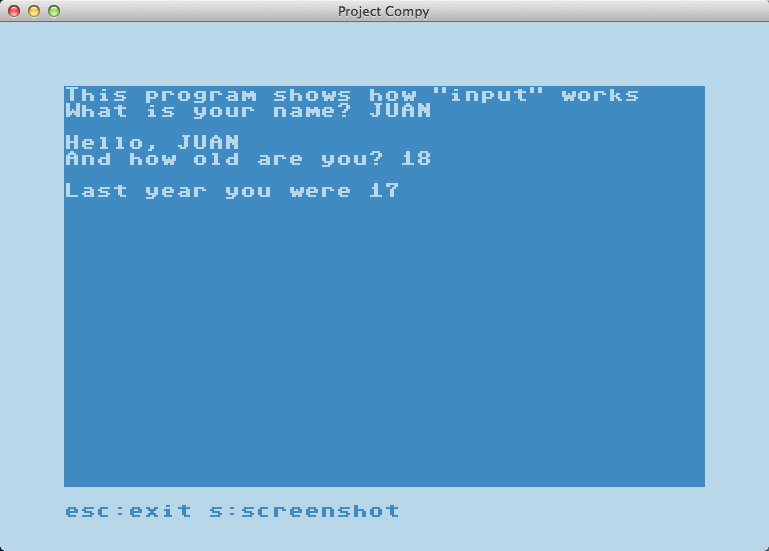
 def my_program():

    clear_screen()

    printf('This program shows how "input" works')

    name = input('What is your name? ')

    printf()

    printf('Hello, ', stay = True)

    printf(name)


    age = input('And how old are you? ')

    printf()

    printf('Last year you were ', stay = True)

    printf(age - 1)


###########################################################################
###########################################################################
# The next lines are needed to run compy, don't mind them,
# but keep them, don't get rid of these lines
###########################################################################
###########################################################################
import compy
import time

# define commands of compy, so IDE's will recognize them
def clear_screen(): pass
def set_bg_color(color): pass
def set_fm_color(color): pass
def printf(to_print='', color=None, stay=False, reverse=False): pass
def xyprintf(x, y, *args): pass
def poke(x, y, code, color = None, reverse=False): pass
def peek(self, x, y): pass
def input(message = '', color=None): return None
def wait_key(): pass
def check_key(): pass

def redefine_commands_and_run(screen):

    global clear_screen, set_bg_color, set_fm_color, printf, xyprintf
    global poke, peek, input, wait_key, check_key

    clear_screen = screen.clear_screen
    set_bg_color = screen.set_bg_color
    set_fm_color = screen.set_fm_color
    printf = screen.printf
    xyprintf = screen.xyprintf
    poke = screen.poke
    peek = screen.peek
    input = screen.input
    wait_key = screen.wait_key
    check_key = screen.check_key

    my_program()

if __name__ == '__main__':
    compy.run(redefine_commands_and_run)

###########################################################################
###########################################################################
Challenge: Sum two numbers
Can you do that?
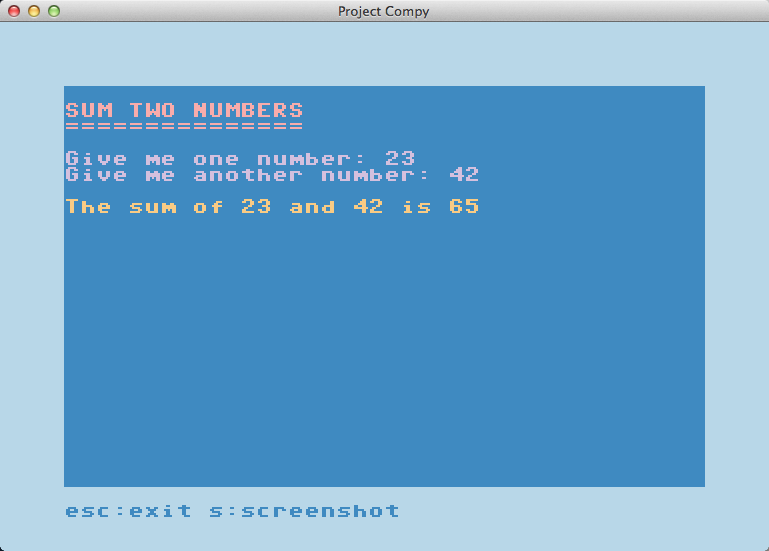
 def my_program():

    clear_screen()

    printf()
    printf('SUM TWO NUMBERS', color=4)
    printf('===============')
    printf()

    first_value = input("Give me one number: ", color=8)

    second_value = input("Give me another number: ")

    sum_of_values = first_value + second_value

    response = 'The sum of {} and {} is {}'.format(first_value, second_value, sum_of_values)

    printf()
    printf(response, color=6)


###########################################################################
###########################################################################
# The next lines are needed to run compy, don't mind them,
# but keep them, don't get rid of these lines
###########################################################################
###########################################################################
import compy
import time

# define commands of compy, so IDE's will recognize them
def clear_screen(): pass
def set_bg_color(color): pass
def set_fm_color(color): pass
def printf(to_print='', color=None, stay=False, reverse=False): pass
def xyprintf(x, y, *args): pass
def poke(x, y, code, color = None, reverse=False): pass
def peek(self, x, y): pass
def input(message = '', color=None): return None
def wait_key(): pass
def check_key(): pass

def redefine_commands_and_run(screen):

    global clear_screen, set_bg_color, set_fm_color, printf, xyprintf
    global poke, peek, input, wait_key, check_key

    clear_screen = screen.clear_screen
    set_bg_color = screen.set_bg_color
    set_fm_color = screen.set_fm_color
    printf = screen.printf
    xyprintf = screen.xyprintf
    poke = screen.poke
    peek = screen.peek
    input = screen.input
    wait_key = screen.wait_key
    check_key = screen.check_key

    my_program()

if __name__ == '__main__':
    compy.run(redefine_commands_and_run)

###########################################################################
###########################################################################
Example: The command if
The command if checks a condition
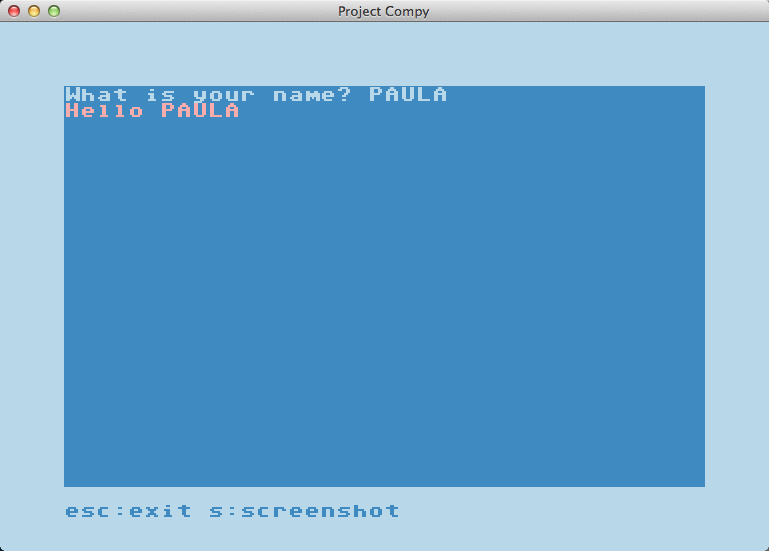
 def my_program():

    clear_screen()

    name = input('What is your name? ')

    if name == 'JUANJO' or name == 'PAULA':
        msg = 'Hello {}'.format(name)

    elif name == 'ANA' or name == 'MIGUEL':
        msg = 'Hello {}'.format(name)

    else:
        msg = 'I do not recognize you, please forget about me, {}'.format(name)

    printf(msg, color=4)


###########################################################################
###########################################################################
# The next lines are needed to run compy, don't mind them,
# but keep them, don't get rid of these lines
###########################################################################
###########################################################################
import compy
import time

# define commands of compy, so IDE's will recognize them
def clear_screen(): pass
def set_bg_color(color): pass
def set_fm_color(color): pass
def printf(to_print='', color=None, stay=False, reverse=False): pass
def xyprintf(x, y, *args): pass
def poke(x, y, code, color = None, reverse=False): pass
def peek(self, x, y): pass
def input(message = '', color=None): return None
def wait_key(): pass
def check_key(): pass

def redefine_commands_and_run(screen):

    global clear_screen, set_bg_color, set_fm_color, printf, xyprintf
    global poke, peek, input, wait_key, check_key

    clear_screen = screen.clear_screen
    set_bg_color = screen.set_bg_color
    set_fm_color = screen.set_fm_color
    printf = screen.printf
    xyprintf = screen.xyprintf
    poke = screen.poke
    peek = screen.peek
    input = screen.input
    wait_key = screen.wait_key
    check_key = screen.check_key

    my_program()

if __name__ == '__main__':
    compy.run(redefine_commands_and_run)

###########################################################################
###########################################################################
Challenge: Find the minimum of two numbers
Can you do that?
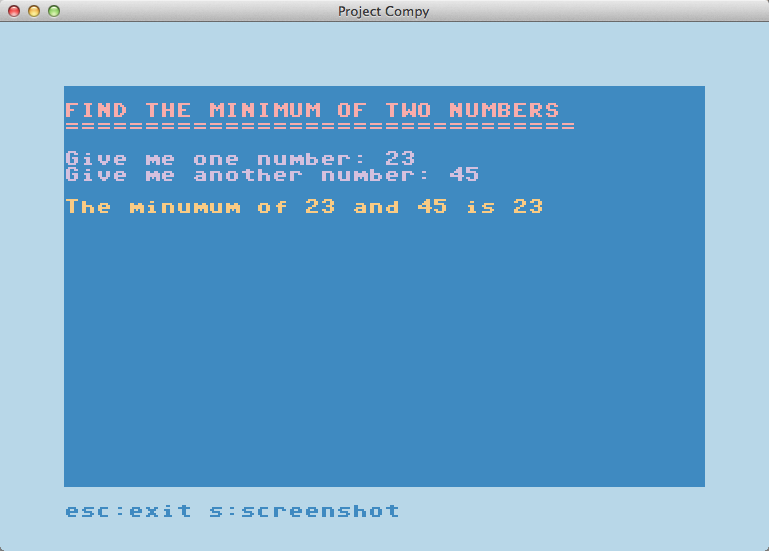
 def my_program():

    clear_screen()

    printf()
    printf('FIND THE MINIMUM OF TWO NUMBERS', color=4)
    printf('================================')
    printf()

    first_value = input("Give me one number: ", color=8)

    second_value = input("Give me another number: ")

    if first_value < second_value:
        minimum = first_value
    else:
        minimum = second_value

    response = 'The minumum of {} and {} is {}'.format(first_value, second_value, minimum)

    printf()
    printf(response, color=6)


###########################################################################
###########################################################################
# The next lines are needed to run compy, don't mind them,
# but keep them, don't get rid of these lines
###########################################################################
###########################################################################
import compy
import time

# define commands of compy, so IDE's will recognize them
def clear_screen(): pass
def set_bg_color(color): pass
def set_fm_color(color): pass
def printf(to_print='', color=None, stay=False, reverse=False): pass
def xyprintf(x, y, *args): pass
def poke(x, y, code, color = None, reverse=False): pass
def peek(self, x, y): pass
def input(message = '', color=None): return None
def wait_key(): pass
def check_key(): pass

def redefine_commands_and_run(screen):

    global clear_screen, set_bg_color, set_fm_color, printf, xyprintf
    global poke, peek, input, wait_key, check_key

    clear_screen = screen.clear_screen
    set_bg_color = screen.set_bg_color
    set_fm_color = screen.set_fm_color
    printf = screen.printf
    xyprintf = screen.xyprintf
    poke = screen.poke
    peek = screen.peek
    input = screen.input
    wait_key = screen.wait_key
    check_key = screen.check_key

    my_program()

if __name__ == '__main__':
    compy.run(redefine_commands_and_run)

###########################################################################
###########################################################################
Example: The command while
The command while loops until it finds the command break
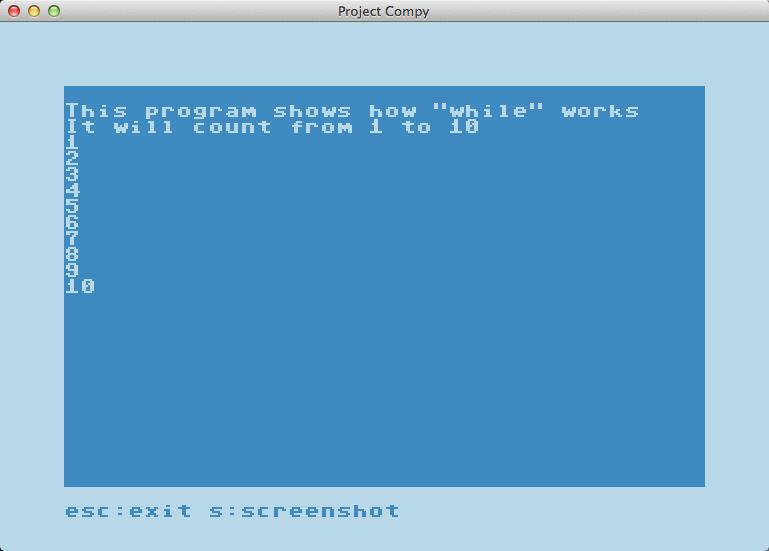
 def my_program():

    clear_screen()

    printf()

    printf('This program shows how "while" works')
    printf('It will count from 1 to 10')

    count = 0

    while True:

        count = count + 1

        printf(count)

        if count == 10:
            break


###########################################################################
###########################################################################
# The next lines are needed to run compy, don't mind them,
# but keep them, don't get rid of these lines
###########################################################################
###########################################################################
import compy
import time

# define commands of compy, so IDE's will recognize them
def clear_screen(): pass
def set_bg_color(color): pass
def set_fm_color(color): pass
def printf(to_print='', color=None, stay=False, reverse=False): pass
def xyprintf(x, y, *args): pass
def poke(x, y, code, color = None, reverse=False): pass
def peek(self, x, y): pass
def input(message = '', color=None): return None
def wait_key(): pass
def check_key(): pass

def redefine_commands_and_run(screen):

    global clear_screen, set_bg_color, set_fm_color, printf, xyprintf
    global poke, peek, input, wait_key, check_key

    clear_screen = screen.clear_screen
    set_bg_color = screen.set_bg_color
    set_fm_color = screen.set_fm_color
    printf = screen.printf
    xyprintf = screen.xyprintf
    poke = screen.poke
    peek = screen.peek
    input = screen.input
    wait_key = screen.wait_key
    check_key = screen.check_key

    my_program()

if __name__ == '__main__':
    compy.run(redefine_commands_and_run)

###########################################################################
###########################################################################
Example: The command sleep
The command sleep stops execution for a given number of seconds
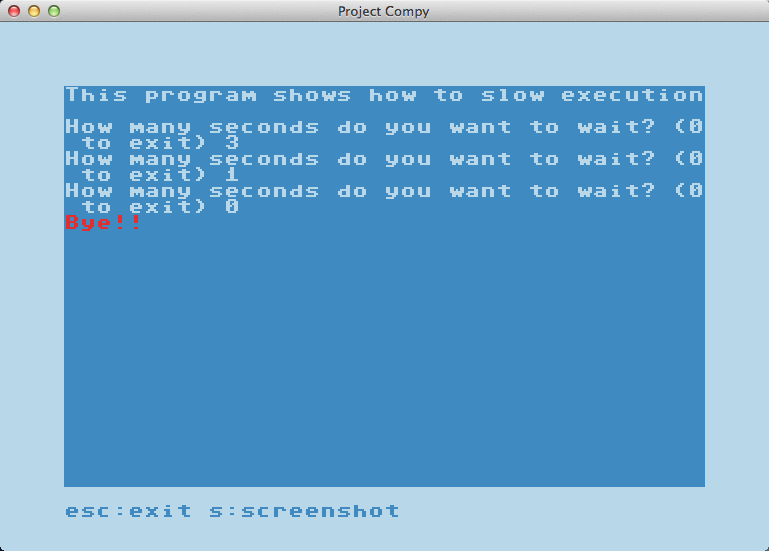
 def my_program():

    clear_screen()

    printf('This program shows how to slow execution')

    while True:
        seconds = input('How many seconds do you want to wait? (0 to exit) ')
        if seconds == 0:
            break
        time.sleep(seconds)

    printf('Bye!!', color='light-red')


###########################################################################
###########################################################################
# The next lines are needed to run compy, don't mind them,
# but keep them, don't get rid of these lines
###########################################################################
###########################################################################
import compy
import time
import datetime as dt
now = dt.datetime.utcnow
import random

# define commands of compy, so IDE's will recognize them
def clear_screen(): pass
def set_bg_color(color): pass
def set_fm_color(color): pass
def printf(to_print='', color=None, stay=False, reverse=False): pass
def xyprintf(x, y, *args): pass
def poke(x, y, code, color = None, reverse=False): pass
def peek(self, x, y): pass
def input(message = '', color=None): return None
def wait_key(): pass
def check_key(): pass

def redefine_commands_and_run(screen):

    global clear_screen, set_bg_color, set_fm_color, printf, xyprintf
    global poke, peek, input, wait_key, check_key

    clear_screen = screen.clear_screen
    set_bg_color = screen.set_bg_color
    set_fm_color = screen.set_fm_color
    printf = screen.printf
    xyprintf = screen.xyprintf
    poke = screen.poke
    peek = screen.peek
    input = screen.input
    wait_key = screen.wait_key
    check_key = screen.check_key

    my_program()

if __name__ == '__main__':
    compy.run(redefine_commands_and_run)

###########################################################################
###########################################################################
Challenge: Validation using a loop
Can you do that?
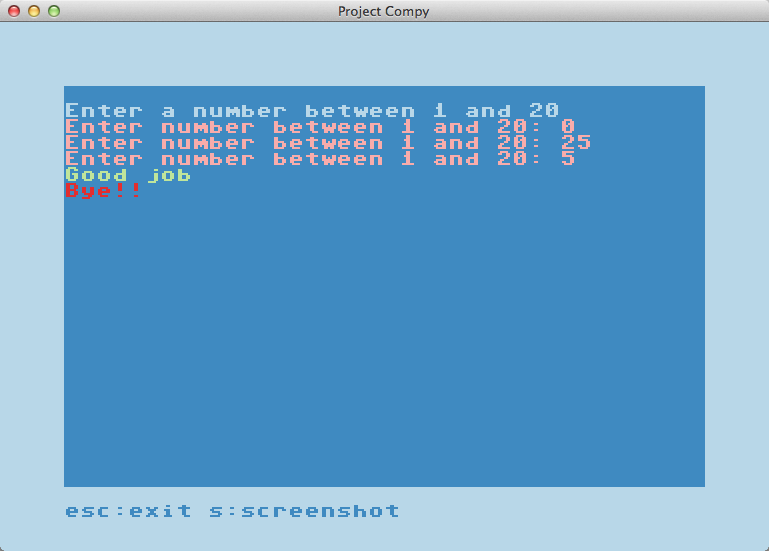
 def my_program():

    clear_screen()

    printf()

    printf('Enter a number between 1 and 20')

    while True:

        answer = input('Enter number between 1 and 20: ', color =4)
        if answer >= 1 and answer <= 20:
            number = answer
            break

    printf('Good job', color=2)

    printf('Bye!!', color='light-red')


###########################################################################
###########################################################################
# The next lines are needed to run compy, don't mind them,
# but keep them, don't get rid of these lines
###########################################################################
###########################################################################
import compy
import time

# define commands of compy, so IDE's will recognize them
def clear_screen(): pass
def set_bg_color(color): pass
def set_fm_color(color): pass
def printf(to_print='', color=None, stay=False, reverse=False): pass
def xyprintf(x, y, *args): pass
def poke(x, y, code, color = None, reverse=False): pass
def peek(self, x, y): pass
def input(message = '', color=None): return None
def wait_key(): pass
def check_key(): pass

def redefine_commands_and_run(screen):

    global clear_screen, set_bg_color, set_fm_color, printf, xyprintf
    global poke, peek, input, wait_key, check_key

    clear_screen = screen.clear_screen
    set_bg_color = screen.set_bg_color
    set_fm_color = screen.set_fm_color
    printf = screen.printf
    xyprintf = screen.xyprintf
    poke = screen.poke
    peek = screen.peek
    input = screen.input
    wait_key = screen.wait_key
    check_key = screen.check_key

    my_program()

if __name__ == '__main__':
    compy.run(redefine_commands_and_run)

###########################################################################
###########################################################################
Challenge: Sum many values entered by user, using a loop
Can you do that?
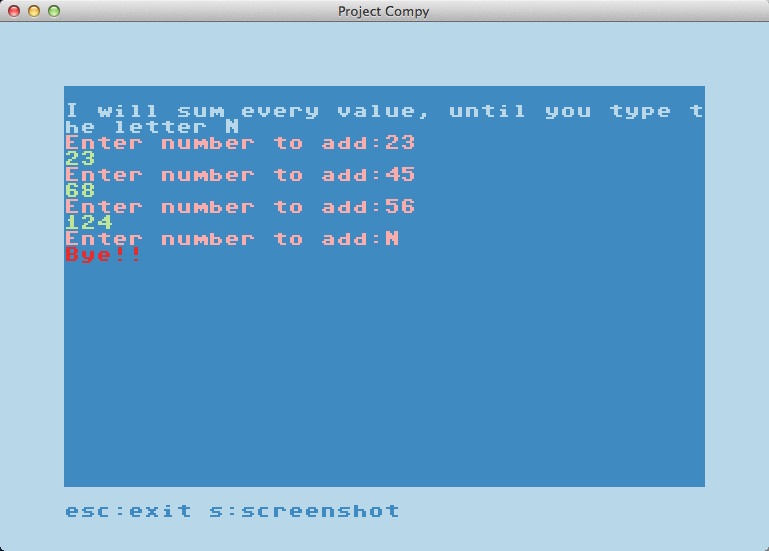
 def my_program():

    clear_screen()

    printf()

    printf('I will sum every value, until you type the letter N')

    sum = 0

    while True:

        answer = input('Enter number to add:', color =4)
        if answer == 'N':
            break
        sum = sum + answer
        printf(sum, color=2)

    printf('Bye!!', color='light-red')


###########################################################################
###########################################################################
# The next lines are needed to run compy, don't mind them,
# but keep them, don't get rid of these lines
###########################################################################
###########################################################################
import compy
import time

# define commands of compy, so IDE's will recognize them
def clear_screen(): pass
def set_bg_color(color): pass
def set_fm_color(color): pass
def printf(to_print='', color=None, stay=False, reverse=False): pass
def xyprintf(x, y, *args): pass
def poke(x, y, code, color = None, reverse=False): pass
def peek(self, x, y): pass
def input(message = '', color=None): return None
def wait_key(): pass
def check_key(): pass

def redefine_commands_and_run(screen):

    global clear_screen, set_bg_color, set_fm_color, printf, xyprintf
    global poke, peek, input, wait_key, check_key

    clear_screen = screen.clear_screen
    set_bg_color = screen.set_bg_color
    set_fm_color = screen.set_fm_color
    printf = screen.printf
    xyprintf = screen.xyprintf
    poke = screen.poke
    peek = screen.peek
    input = screen.input
    wait_key = screen.wait_key
    check_key = screen.check_key

    my_program()

if __name__ == '__main__':
    compy.run(redefine_commands_and_run)

###########################################################################
###########################################################################
Challenge: Find the minimum of many values entered by the user
Can you do that?
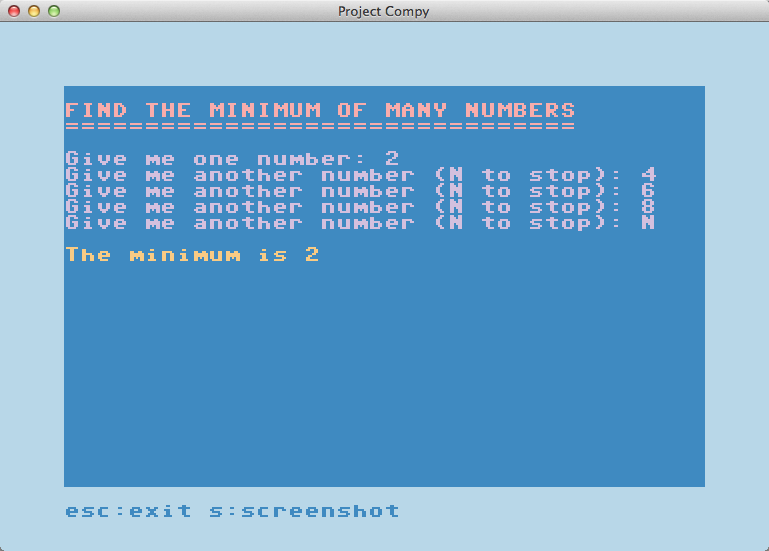
 def my_program():

    clear_screen()

    printf()
    printf('FIND THE MINIMUM OF MANY NUMBERS', color=4)
    printf('================================')
    printf()


    minimum = input("Give me one number: ", color=8)
    while True:
        new_value = input("Give me another number (N to stop): ")
        if new_value == 'N':
            break
        if new_value < minimum:
            minimum = new_value

    response = 'The minimum is {}'.format(minimum)

    printf()
    printf(response, color=6)


###########################################################################
###########################################################################
# The next lines are needed to run compy, don't mind them,
# but keep them, don't get rid of these lines
###########################################################################
###########################################################################
import compy
import time

# define commands of compy, so IDE's will recognize them
def clear_screen(): pass
def set_bg_color(color): pass
def set_fm_color(color): pass
def printf(to_print='', color=None, stay=False, reverse=False): pass
def xyprintf(x, y, *args): pass
def poke(x, y, code, color = None, reverse=False): pass
def peek(self, x, y): pass
def input(message = '', color=None): return None
def wait_key(): pass
def check_key(): pass

def redefine_commands_and_run(screen):

    global clear_screen, set_bg_color, set_fm_color, printf, xyprintf
    global poke, peek, input, wait_key, check_key

    clear_screen = screen.clear_screen
    set_bg_color = screen.set_bg_color
    set_fm_color = screen.set_fm_color
    printf = screen.printf
    xyprintf = screen.xyprintf
    poke = screen.poke
    peek = screen.peek
    input = screen.input
    wait_key = screen.wait_key
    check_key = screen.check_key

    my_program()

if __name__ == '__main__':
    compy.run(redefine_commands_and_run)

###########################################################################
###########################################################################
Challenge: Make a long word
Can you do that?
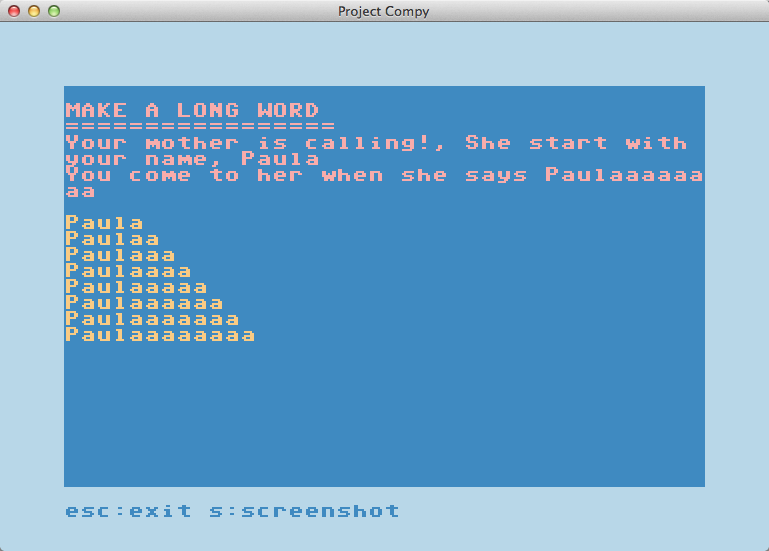
 def my_program():

    clear_screen()

    printf()
    printf('MAKE A LONG WORD', color=4)
    printf('=================')

    printf('Your mother is calling!, She start with your name, Paula')
    printf('You come to her when she says Paulaaaaaaaa')
    printf(color=6)

    word = 'Paula'
    while True:
        printf(word)
        if word == 'Paulaaaaaaaa':
            break
        word = '{}a'.format(word)


###########################################################################
###########################################################################
# The next lines are needed to run compy, don't mind them,
# but keep them, don't get rid of these lines
###########################################################################
###########################################################################
import compy
import time

# define commands of compy, so IDE's will recognize them
def clear_screen(): pass
def set_bg_color(color): pass
def set_fm_color(color): pass
def printf(to_print='', color=None, stay=False, reverse=False): pass
def xyprintf(x, y, *args): pass
def poke(x, y, code, color = None, reverse=False): pass
def peek(self, x, y): pass
def input(message = '', color=None): return None
def wait_key(): pass
def check_key(): pass

def redefine_commands_and_run(screen):

    global clear_screen, set_bg_color, set_fm_color, printf, xyprintf
    global poke, peek, input, wait_key, check_key

    clear_screen = screen.clear_screen
    set_bg_color = screen.set_bg_color
    set_fm_color = screen.set_fm_color
    printf = screen.printf
    xyprintf = screen.xyprintf
    poke = screen.poke
    peek = screen.peek
    input = screen.input
    wait_key = screen.wait_key
    check_key = screen.check_key

    my_program()

if __name__ == '__main__':
    compy.run(redefine_commands_and_run)

###########################################################################
###########################################################################
Challenge: Squares table
Can you do that?
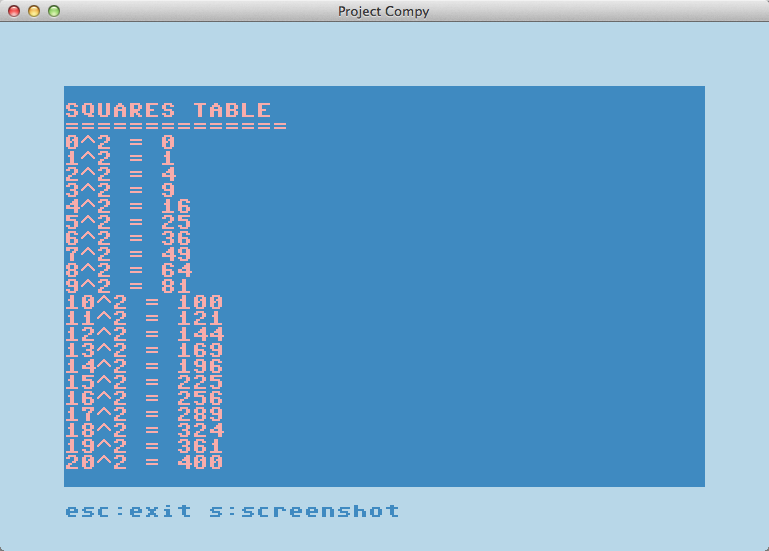
 def my_program():

    clear_screen()

    printf()
    printf('SQUARES TABLE', color=4)
    printf('==============')

    number = 0
    while True:
        result = number ** 2
        msg = '{}^2 = {}'.format(number, result)
        printf(msg)
        time.sleep(0.1)
        if number == 20:
            break
        number = number +1


###########################################################################
###########################################################################
# The next lines are needed to run compy, don't mind them,
# but keep them, don't get rid of these lines
###########################################################################
###########################################################################
import compy
import time

# define commands of compy, so IDE's will recognize them
def clear_screen(): pass
def set_bg_color(color): pass
def set_fm_color(color): pass
def printf(to_print='', color=None, stay=False, reverse=False): pass
def xyprintf(x, y, *args): pass
def poke(x, y, code, color = None, reverse=False): pass
def peek(self, x, y): pass
def input(message = '', color=None): return None
def wait_key(): pass
def check_key(): pass

def redefine_commands_and_run(screen):

    global clear_screen, set_bg_color, set_fm_color, printf, xyprintf
    global poke, peek, input, wait_key, check_key

    clear_screen = screen.clear_screen
    set_bg_color = screen.set_bg_color
    set_fm_color = screen.set_fm_color
    printf = screen.printf
    xyprintf = screen.xyprintf
    poke = screen.poke
    peek = screen.peek
    input = screen.input
    wait_key = screen.wait_key
    check_key = screen.check_key

    my_program()

if __name__ == '__main__':
    compy.run(redefine_commands_and_run)

###########################################################################
###########################################################################
Challenge: Exponential table
Can you do that?
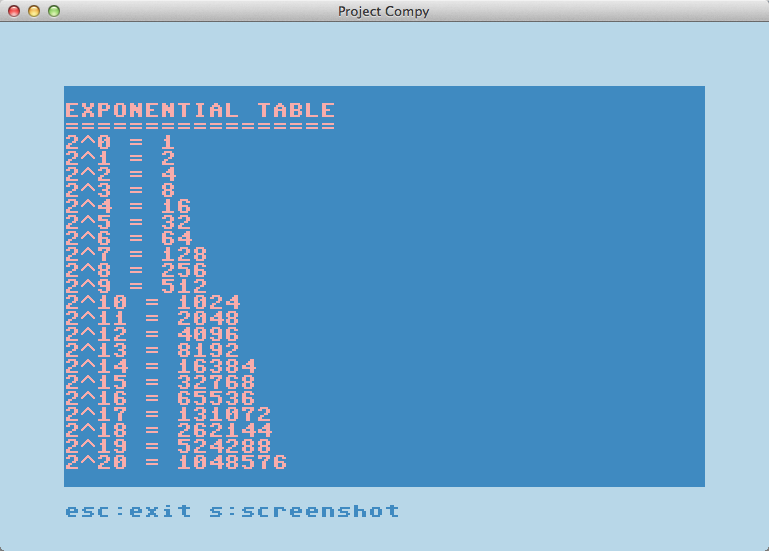
 import wait_time

def my_program():

    clear_screen()

    printf()
    printf('EXPONENTIAL TABLE', color=4)
    printf('=================')

    number = 0
    while True:
        result = 2 ** number
        msg = '2^{} = {}'.format(number, result)
        printf(msg)
        wait_time.sleep(0.1)
        if number == 20:
            break
        number = number +1


###########################################################################
###########################################################################
# The next lines are needed to run compy, don't mind them,
# but keep them, don't get rid of these lines
###########################################################################
###########################################################################
import compy
import time

# define commands of compy, so IDE's will recognize them
def clear_screen(): pass
def set_bg_color(color): pass
def set_fm_color(color): pass
def printf(to_print='', color=None, stay=False, reverse=False): pass
def xyprintf(x, y, *args): pass
def poke(x, y, code, color = None, reverse=False): pass
def peek(self, x, y): pass
def input(message = '', color=None): return None
def wait_key(): pass
def check_key(): pass

def redefine_commands_and_run(screen):

    global clear_screen, set_bg_color, set_fm_color, printf, xyprintf
    global poke, peek, input, wait_key, check_key

    clear_screen = screen.clear_screen
    set_bg_color = screen.set_bg_color
    set_fm_color = screen.set_fm_color
    printf = screen.printf
    xyprintf = screen.xyprintf
    poke = screen.poke
    peek = screen.peek
    input = screen.input
    wait_key = screen.wait_key
    check_key = screen.check_key

    my_program()

if __name__ == '__main__':
    compy.run(redefine_commands_and_run)

###########################################################################
###########################################################################
Challenge: Multiplication table
Can you do that?
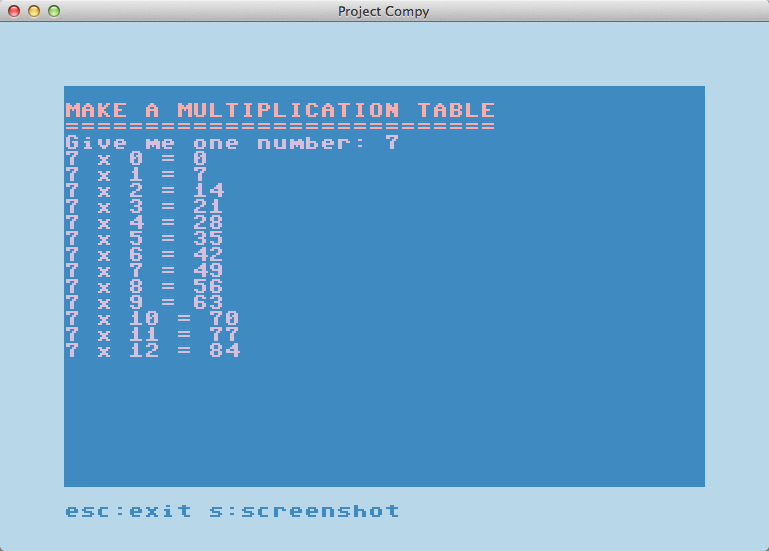
 def my_program():

    clear_screen()

    printf()
    printf('MAKE A MULTIPLICATION TABLE', color=4)
    printf('===========================')

    multiplier = input("Give me one number: ", color=8)
    m2 = 0
    while True:
        result = multiplier * m2
        msg = '{} x {} = {}'.format(multiplier, m2, result)
        printf(msg)
        if m2 == 12:
            break
        m2 = m2 +1


###########################################################################
###########################################################################
# The next lines are needed to run compy, don't mind them,
# but keep them, don't get rid of these lines
###########################################################################
###########################################################################
import compy
import time

# define commands of compy, so IDE's will recognize them
def clear_screen(): pass
def set_bg_color(color): pass
def set_fm_color(color): pass
def printf(to_print='', color=None, stay=False, reverse=False): pass
def xyprintf(x, y, *args): pass
def poke(x, y, code, color = None, reverse=False): pass
def peek(self, x, y): pass
def input(message = '', color=None): return None
def wait_key(): pass
def check_key(): pass

def redefine_commands_and_run(screen):

    global clear_screen, set_bg_color, set_fm_color, printf, xyprintf
    global poke, peek, input, wait_key, check_key

    clear_screen = screen.clear_screen
    set_bg_color = screen.set_bg_color
    set_fm_color = screen.set_fm_color
    printf = screen.printf
    xyprintf = screen.xyprintf
    poke = screen.poke
    peek = screen.peek
    input = screen.input
    wait_key = screen.wait_key
    check_key = screen.check_key

    my_program()

if __name__ == '__main__':
    compy.run(redefine_commands_and_run)

###########################################################################
###########################################################################
Example: Generating random numbers
Look at the way to generate random numbers in python
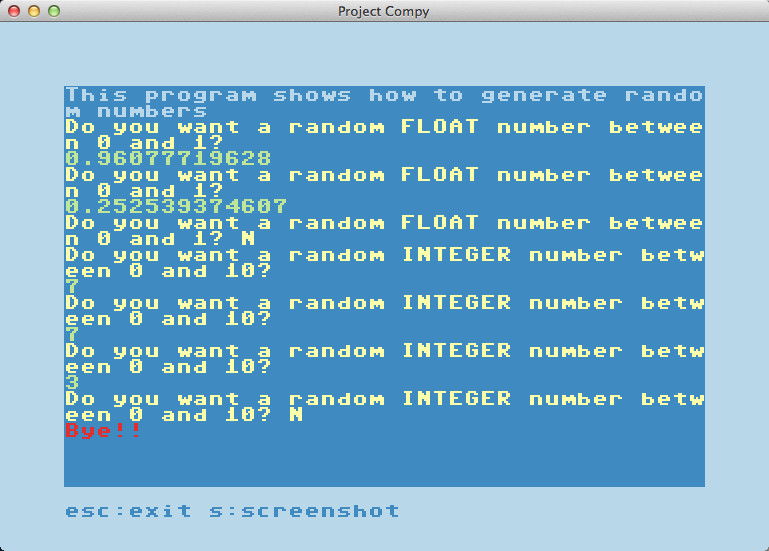
 def my_program():

    clear_screen()

    printf('This program shows how to generate random numbers')

    while True:
        answer = input('Do you want a random FLOAT number between 0 and 1? ', color='yellow')
        if answer == 'N':
            break
        number = random.random()
        printf(number, color='light-green')

    while True:
        answer = input('Do you want a random INTEGER number between 0 and 10? ', color='yellow')
        if answer == 'N':
            break
        number = random.randint(0,10)
        printf(number, color='light-green')

    printf('Bye!!', color='light-red')


###########################################################################
###########################################################################
# The next lines are needed to run compy, don't mind them,
# but keep them, don't get rid of these lines
###########################################################################
###########################################################################
import compy
import time
import datetime as dt
now = dt.datetime.utcnow
import random

# define commands of compy, so IDE's will recognize them
def clear_screen(): pass
def set_bg_color(color): pass
def set_fm_color(color): pass
def printf(to_print='', color=None, stay=False, reverse=False): pass
def xyprintf(x, y, *args): pass
def poke(x, y, code, color = None, reverse=False): pass
def peek(self, x, y): pass
def input(message = '', color=None): return None
def wait_key(): pass
def check_key(): pass

def redefine_commands_and_run(screen):

    global clear_screen, set_bg_color, set_fm_color, printf, xyprintf
    global poke, peek, input, wait_key, check_key

    clear_screen = screen.clear_screen
    set_bg_color = screen.set_bg_color
    set_fm_color = screen.set_fm_color
    printf = screen.printf
    xyprintf = screen.xyprintf
    poke = screen.poke
    peek = screen.peek
    input = screen.input
    wait_key = screen.wait_key
    check_key = screen.check_key

    my_program()

if __name__ == '__main__':
    compy.run(redefine_commands_and_run)

###########################################################################
###########################################################################
Challenge: Guess the number
Can you do that?
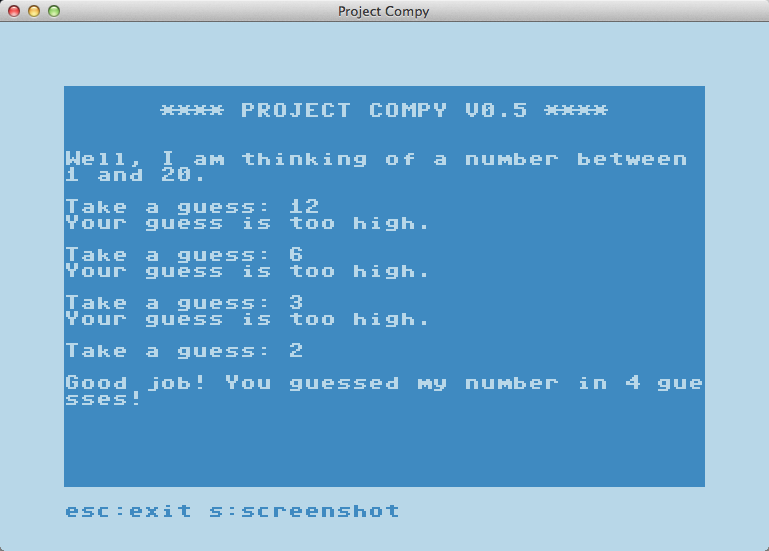
  # This is a guess the number game.
import random


def main(sc):

    sc.printf('Well, I am thinking of a number between 1 and 20.')
    sc.printf()

    number = random.randint(1, 20)
    num_guesses_taken = 0
    while True:
        guess = sc.input('Take a guess: ')
        guess = int(guess)
        num_guesses_taken = num_guesses_taken + 1
        if guess < number:
            sc.printf('Your guess is too low.')

        elif guess > number:
            sc.printf('Your guess is too high.')

        elif guess == number:
            sc.printf()
            msg = 'Good job! You guessed my number in {} guesses!'.format(num_guesses_taken)
            sc.printf(msg)
            break
        else:
            pass # Don't do anything

        sc.printf()

        if num_guesses_taken == 5:
            msg='Nope. The number I was thinking of was {}'.format(number)
            sc.printf(msg)
            break


###########################################################################
###########################################################################
# The next lines are needed to run compy, don't mind them,
# but keep them, don't get rid of these lines
###########################################################################
###########################################################################
import compy
import time
import datetime as dt
now = dt.datetime.utcnow

# define commands of compy, so IDE's will recognize them
def clear_screen(): pass
def set_bg_color(color): pass
def set_fm_color(color): pass
def printf(to_print='', color=None, stay=False, reverse=False): pass
def xyprintf(x, y, *args): pass
def poke(x, y, code, color = None, reverse=False): pass
def peek(self, x, y): pass
def input(message = '', color=None): return None
def wait_key(): pass
def check_key(): pass

def redefine_commands_and_run(screen):

    global clear_screen, set_bg_color, set_fm_color, printf, xyprintf
    global poke, peek, input, wait_key, check_key

    clear_screen = screen.clear_screen
    set_bg_color = screen.set_bg_color
    set_fm_color = screen.set_fm_color
    printf = screen.printf
    xyprintf = screen.xyprintf
    poke = screen.poke
    peek = screen.peek
    input = screen.input
    wait_key = screen.wait_key
    check_key = screen.check_key

    my_program()

if __name__ == '__main__':
    compy.run(redefine_commands_and_run)

###########################################################################
###########################################################################
Example: The command def
The command def defines new commands
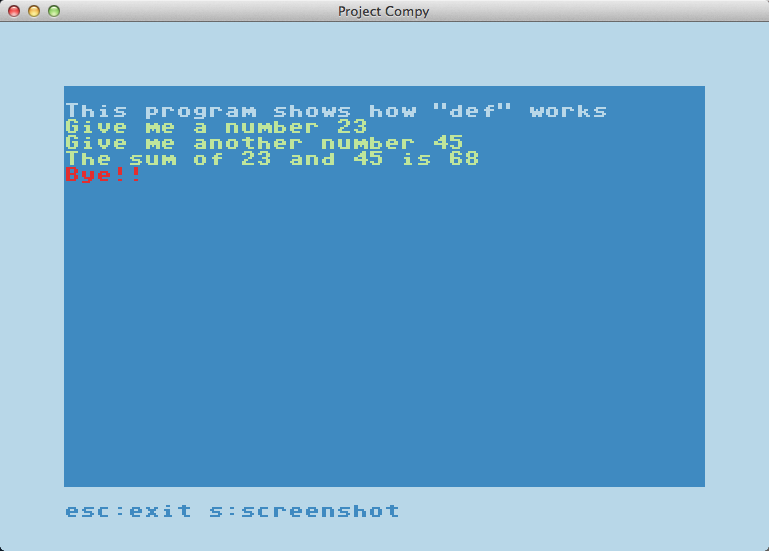
 def my_program():

    clear_screen()

    printf()

    printf('This program shows how "def" works')

    first, second = ask_for_two_numbers()

    sum_of_numbers = sum_two_numbers(first, second)

    print_response(first, second, sum_of_numbers)

    printf('Bye!!', color='light-red')


# This function doesn't receive values, but returns two values
def ask_for_two_numbers():
    n1 = input('Give me a number ', color='light-green')
    n2 = input('Give me another number ', color='light-green')
    return n1, n2


# This function receives two values and returns one
def sum_two_numbers(n1, n2):
    sum = n1 + n2
    return sum


# This function receives three values, but doesn't return any
def print_response(n1, n2, sum):
    response = 'The sum of {} and {} is {}'.format(n1, n2, sum)
    printf(response)


###########################################################################
###########################################################################
# The next lines are needed to run compy, don't mind them,
# but keep them, don't get rid of these lines
###########################################################################
###########################################################################
import compy
import time

# define commands of compy, so IDE's will recognize them
def clear_screen(): pass
def set_bg_color(color): pass
def set_fm_color(color): pass
def printf(to_print='', color=None, stay=False, reverse=False): pass
def xyprintf(x, y, *args): pass
def poke(x, y, code, color = None, reverse=False): pass
def peek(self, x, y): pass
def input(message = '', color=None): return None
def wait_key(): pass
def check_key(): pass

def redefine_commands_and_run(screen):

    global clear_screen, set_bg_color, set_fm_color, printf, xyprintf
    global poke, peek, input, wait_key, check_key

    clear_screen = screen.clear_screen
    set_bg_color = screen.set_bg_color
    set_fm_color = screen.set_fm_color
    printf = screen.printf
    xyprintf = screen.xyprintf
    poke = screen.poke
    peek = screen.peek
    input = screen.input
    wait_key = screen.wait_key
    check_key = screen.check_key

    my_program()

if __name__ == '__main__':
    compy.run(redefine_commands_and_run)

###########################################################################
###########################################################################
Challenge: Draw a square
Can you do that? Use the def word.
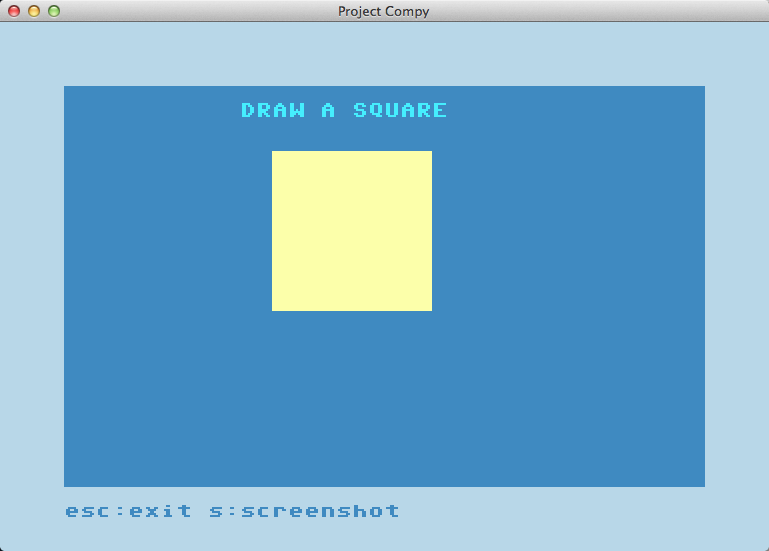
 def my_program():

    clear_screen()

    printf()
    printf('           DRAW A SQUARE', color=17)
    printf()
    printf()
    n=0
    while True:
        n = n + 1
        draw_line()
        if n == 10:
            break


def draw_line():
    printf('             ', stay=True)
    printf('          ', reverse=True, color='light-yellow')


###########################################################################
###########################################################################
# The next lines are needed to run compy, don't mind them,
# but keep them, don't get rid of these lines
###########################################################################
###########################################################################
import compy
import time

# define commands of compy, so IDE's will recognize them
def clear_screen(): pass
def set_bg_color(color): pass
def set_fm_color(color): pass
def printf(to_print='', color=None, stay=False, reverse=False): pass
def xyprintf(x, y, *args): pass
def poke(x, y, code, color = None, reverse=False): pass
def peek(self, x, y): pass
def input(message = '', color=None): return None
def wait_key(): pass
def check_key(): pass

def redefine_commands_and_run(screen):

    global clear_screen, set_bg_color, set_fm_color, printf, xyprintf
    global poke, peek, input, wait_key, check_key

    clear_screen = screen.clear_screen
    set_bg_color = screen.set_bg_color
    set_fm_color = screen.set_fm_color
    printf = screen.printf
    xyprintf = screen.xyprintf
    poke = screen.poke
    peek = screen.peek
    input = screen.input
    wait_key = screen.wait_key
    check_key = screen.check_key

    my_program()

if __name__ == '__main__':
    compy.run(redefine_commands_and_run)

###########################################################################
###########################################################################
Challenge: Draw a right pointing ladder
Can you do that? Use the def word.
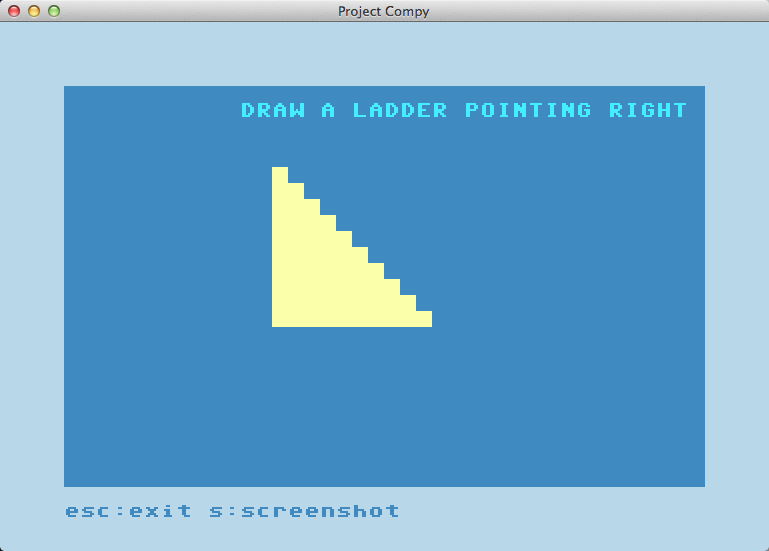
 def my_program():

    clear_screen()

    printf()
    printf('           DRAW A LADDER POINTING RIGHT', color=17)
    printf()
    printf()
    printf()
    n=0
    while True:
        n = n + 1
        draw_line(n)
        if n == 10:
            break


def draw_line(n):
    printf('             ', stay=True)
    printf(' '*n, reverse=True, color='light-yellow')


###########################################################################
###########################################################################
# The next lines are needed to run compy, don't mind them,
# but keep them, don't get rid of these lines
###########################################################################
###########################################################################
import compy
import time

# define commands of compy, so IDE's will recognize them
def clear_screen(): pass
def set_bg_color(color): pass
def set_fm_color(color): pass
def printf(to_print='', color=None, stay=False, reverse=False): pass
def xyprintf(x, y, *args): pass
def poke(x, y, code, color = None, reverse=False): pass
def peek(self, x, y): pass
def input(message = '', color=None): return None
def wait_key(): pass
def check_key(): pass

def redefine_commands_and_run(screen):

    global clear_screen, set_bg_color, set_fm_color, printf, xyprintf
    global poke, peek, input, wait_key, check_key

    clear_screen = screen.clear_screen
    set_bg_color = screen.set_bg_color
    set_fm_color = screen.set_fm_color
    printf = screen.printf
    xyprintf = screen.xyprintf
    poke = screen.poke
    peek = screen.peek
    input = screen.input
    wait_key = screen.wait_key
    check_key = screen.check_key

    my_program()

if __name__ == '__main__':
    compy.run(redefine_commands_and_run)

###########################################################################
###########################################################################
Challenge: Draw a left pointing ladder
Can you do that? Use the def word.
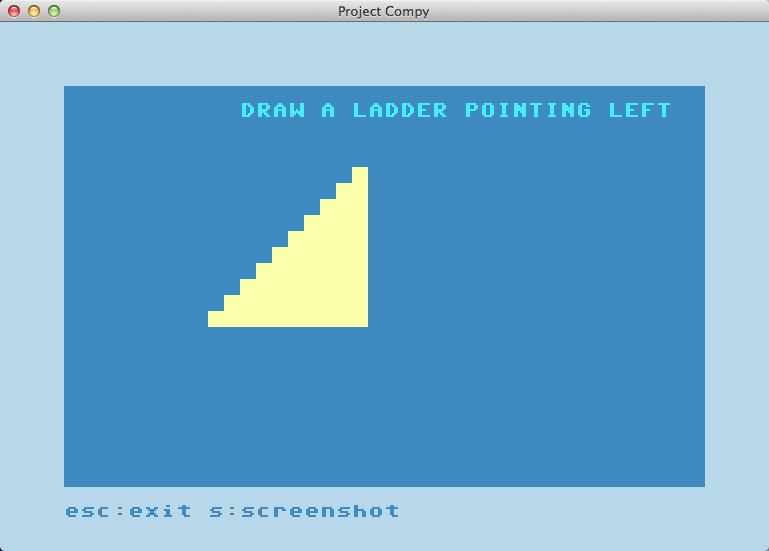
 def my_program():

    clear_screen()

    printf()
    printf('           DRAW A LADDER POINTING LEFT', color=17)
    printf()
    printf()
    printf()
    n=0
    while True:
        n = n + 1
        draw_line(n)
        if n == 10:
            break


def draw_line(n):
    printf('        ', stay=True)
    space = 11 -n
    printf(' '*space, stay=True)
    printf(' '*n, reverse=True, color='light-yellow')


###########################################################################
###########################################################################
# The next lines are needed to run compy, don't mind them,
# but keep them, don't get rid of these lines
###########################################################################
###########################################################################
import compy
import time

# define commands of compy, so IDE's will recognize them
def clear_screen(): pass
def set_bg_color(color): pass
def set_fm_color(color): pass
def printf(to_print='', color=None, stay=False, reverse=False): pass
def xyprintf(x, y, *args): pass
def poke(x, y, code, color = None, reverse=False): pass
def peek(self, x, y): pass
def input(message = '', color=None): return None
def wait_key(): pass
def check_key(): pass

def redefine_commands_and_run(screen):

    global clear_screen, set_bg_color, set_fm_color, printf, xyprintf
    global poke, peek, input, wait_key, check_key

    clear_screen = screen.clear_screen
    set_bg_color = screen.set_bg_color
    set_fm_color = screen.set_fm_color
    printf = screen.printf
    xyprintf = screen.xyprintf
    poke = screen.poke
    peek = screen.peek
    input = screen.input
    wait_key = screen.wait_key
    check_key = screen.check_key

    my_program()

if __name__ == '__main__':
    compy.run(redefine_commands_and_run)

###########################################################################
###########################################################################
Challenge: Draw a pyramid
Can you do that? Use the def word.
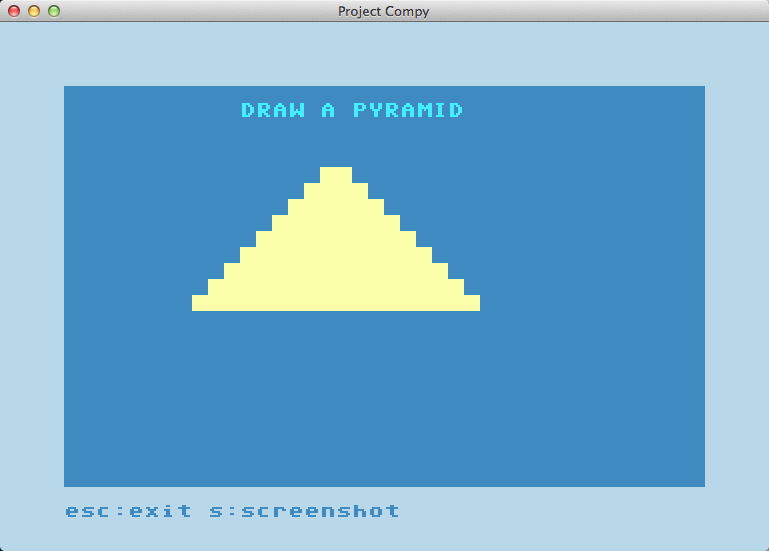
 def my_program():

    clear_screen()

    printf()
    printf('           DRAW A PYRAMID', color=17)
    printf()
    printf()
    printf()
    n=0
    while True:
        n = n + 1
        draw_line(n)
        if n == 9:
            break


def draw_line(n):
    printf('       ', stay=True)
    spaces=10-n
    printf(' '*spaces, stay=True)
    printf(' '*n*2, reverse=True, color='light-yellow')


###########################################################################
###########################################################################
# The next lines are needed to run compy, don't mind them,
# but keep them, don't get rid of these lines
###########################################################################
###########################################################################
import compy
import time

# define commands of compy, so IDE's will recognize them
def clear_screen(): pass
def set_bg_color(color): pass
def set_fm_color(color): pass
def printf(to_print='', color=None, stay=False, reverse=False): pass
def xyprintf(x, y, *args): pass
def poke(x, y, code, color = None, reverse=False): pass
def peek(self, x, y): pass
def input(message = '', color=None): return None
def wait_key(): pass
def check_key(): pass

def redefine_commands_and_run(screen):

    global clear_screen, set_bg_color, set_fm_color, printf, xyprintf
    global poke, peek, input, wait_key, check_key

    clear_screen = screen.clear_screen
    set_bg_color = screen.set_bg_color
    set_fm_color = screen.set_fm_color
    printf = screen.printf
    xyprintf = screen.xyprintf
    poke = screen.poke
    peek = screen.peek
    input = screen.input
    wait_key = screen.wait_key
    check_key = screen.check_key

    my_program()

if __name__ == '__main__':
    compy.run(redefine_commands_and_run)

###########################################################################
###########################################################################
Example: Start printing in a specific place: xyprint
xyprintf prints in a fixed position
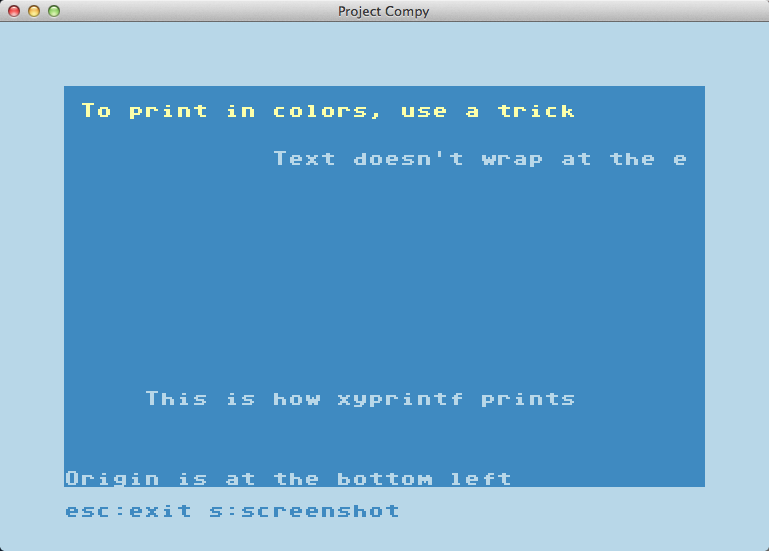
 def my_program():

    clear_screen()

    xyprintf(5, 5, 'This is how xyprintf prints')

    xyprintf(0, 0, 'Origin is at the bottom left')

    xyprintf(13, 20, "Text doesn't wrap at the end of the line ")

    printf(color='light-yellow')

    xyprintf(1, 23, 'To print in colors, use a trick')


###########################################################################
###########################################################################
# The next lines are needed to run compy, don't mind them,
# but keep them, don't get rid of these lines
###########################################################################
###########################################################################
import compy
import time

# define commands of compy, so IDE's will recognize them
def clear_screen(): pass
def set_bg_color(color): pass
def set_fm_color(color): pass
def printf(to_print='', color=None, stay=False, reverse=False): pass
def xyprintf(x, y, *args): pass
def poke(x, y, code, color = None, reverse=False): pass
def peek(self, x, y): pass
def input(message = '', color=None): return None
def wait_key(): pass
def check_key(): pass

def redefine_commands_and_run(screen):

    global clear_screen, set_bg_color, set_fm_color, printf, xyprintf
    global poke, peek, input, wait_key, check_key

    clear_screen = screen.clear_screen
    set_bg_color = screen.set_bg_color
    set_fm_color = screen.set_fm_color
    printf = screen.printf
    xyprintf = screen.xyprintf
    poke = screen.poke
    peek = screen.peek
    input = screen.input
    wait_key = screen.wait_key
    check_key = screen.check_key

    my_program()

if __name__ == '__main__':
    compy.run(redefine_commands_and_run)

###########################################################################
###########################################################################
Example: Use the date and time
Look at the way to obtain the current date and time
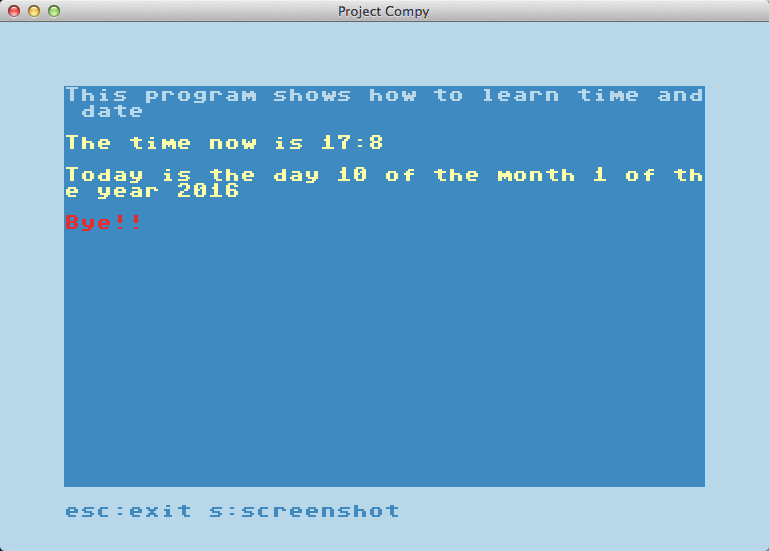
 def my_program():

    clear_screen()

    printf('This program shows how to learn time and date')

    time = now()

    printf(color='yellow')
    printf('The time now is {}:{}'.format(time.hour, time.minute))

    printf()

    printf('Today is the day {} of the month {} of the year {}'.format(time.day, time.month, time.year))

    printf()
    printf('Bye!!', color='light-red')


###########################################################################
###########################################################################
# The next lines are needed to run compy, don't mind them,
# but keep them, don't get rid of these lines
###########################################################################
###########################################################################
import compy
import time
import datetime as dt
now = dt.datetime.now
import random

# define commands of compy, so IDE's will recognize them
def clear_screen(): pass
def set_bg_color(color): pass
def set_fm_color(color): pass
def printf(to_print='', color=None, stay=False, reverse=False): pass
def xyprintf(x, y, *args): pass
def poke(x, y, code, color = None, reverse=False): pass
def peek(self, x, y): pass
def input(message = '', color=None): return None
def wait_key(): pass
def check_key(): pass

def redefine_commands_and_run(screen):

    global clear_screen, set_bg_color, set_fm_color, printf, xyprintf
    global poke, peek, input, wait_key, check_key

    clear_screen = screen.clear_screen
    set_bg_color = screen.set_bg_color
    set_fm_color = screen.set_fm_color
    printf = screen.printf
    xyprintf = screen.xyprintf
    poke = screen.poke
    peek = screen.peek
    input = screen.input
    wait_key = screen.wait_key
    check_key = screen.check_key

    my_program()

if __name__ == '__main__':
    compy.run(redefine_commands_and_run)

###########################################################################
###########################################################################